Five-axis CNC machining of aircraft turbine engine blades
Table of Contents
Some people say that the high-pressure turbine blade is the world’s most difficult material preparation. The working environment is extremely harsh: high temperature, pressure, and strength! The fact is also true; the aero-engine is a highly complex and sophisticated thermal machinery to provide aircraft with the power needed to fly the engine; its manufacturing process is very complex, and the engine’s performance depends largely on the blade type design and manufacturing level. Therefore we also compare the aero-engine to the industrial crown jewel. In the aero-engine, the core, processing, and production of the most complex components is the turbine blade; blade processing is not three words that can say clearly. This article briefly explains why the aircraft turbine engine blade is difficult and how it should be processed.
Why must the aircraft turbine engine blade use a five-axis CNC machining process?
The blade is a typical class of free-form parts; the processing of such parts has a characteristic: thin, easy to process deformation, and the material is usually stainless steel, Monel, INCONEL, titanium, and nickel-based difficult-to-machine alloy materials, adding to the degree of difficulty of processing, while the machining process and processing with the tool to put forward higher requirements. These blades require precision manufacturing processes to produce parts with tight tolerances and complex geometries to ensure their performance and reliability. And five-axis CNC machining offers high precision, flexibility, and speed, making it ideal for producing complex parts such as aircraft turbine engine blades.
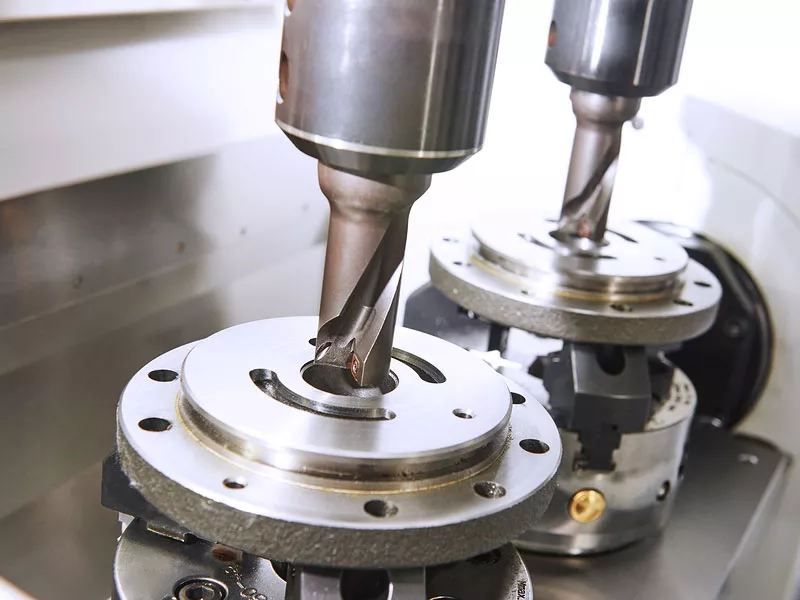
Five-axis machining centers are often used in high-end manufacturing as intelligent machining equipment with a high degree of automation. Five-axis machining centers are suitable for free-form machining airframes, turbine engine parts on aircraft ships, and impellers. We can find that the workpiece suitable for five-axis machining centers has a high degree of curved surface; through a clamping difficult to process the shape of the characteristics, so five-axis machine tools can not change the position of the workpiece on the machine, the workpiece on different sides of the processing, greatly improving the processing efficiency of prismatic parts.
Five-axis machining center has three moving axes, X, Y, Z, and any two rotary axes; compared to the traditional three-axis machining center, the five-axis machining center of five-axis linkage technology in the processing of more complex geometry of the workpiece, the tool can be positioned and operated in five degrees of freedom. The machine tools used for 5-axis machining are often called 5-axis or 5-axis machining centers. Five-axis machining is commonly used in the aerospace industry to machine free-form airframe components, turbine components, and impellers. Five-axis machine tools can not change the position of the workpiece on the machine, and the different sides of the workpiece for processing can greatly improve the efficiency of the colorful parts processing.
Aircraft turbine engine blades have complex shapes and contours with complex features such as wings, twists, and curves. Most are high-strength materials like titanium, nickel, and cobalt-based alloys. And performance depends heavily on their dimensional accuracy and surface finish. Five-axis CNC machines can produce parts with consistent quality and precision, thus reducing the risk of defects or errors. This is particularly important in the aerospace industry, where safety and reliability are key factors.
Five-axis CNC machining is important for producing high-quality, reliable, and efficient aero-turbine engine blades. Its ability to produce complex geometries, tight tolerances, optimized material usage, and efficiency and productivity make it an important technology for the aerospace industry.
Difficulties in CNC machining of aircraft turbine engine blades
The shape of the aero-engine blade is very complex and greatly impacts the engine performance, long design and development cycle, and large manufacturing workload. Its aero-engine blade five-axis machining technology has been regarded as an important issue in the manufacturing industry. As the shape of the aero-engine blade is more complex, the blade twist is large; processing is very easy to interfere with, so its processing difficulties in the runner, blade rough, and finish machining.
Therefore, its processing difficulties, blade shape structure, and processing quality requirements characteristics are directly related. The blade shape overall has an irregular three-dimensional space surface form, making its processing method constitutes a professional nature. At the same time, the thin wall form and become the surface structure accuracy requirements to achieve always can not avoid the influence of factors. The blade surface quality is a nearly demanding requirement, and molding accuracy is to ensure the processing. The way to choose must consider the problem.
And because the blade is to the aero-engine high temperature and high-pressure gas medium to implement the role, by the centrifugal, gas flushing and compound vibration and other properties of the alternating stress effect, making its material properties must have light, high strength, high fatigue resistance and corrosion resistance and other comprehensive performance, for this reason, the parts of the material presents a more complex difficult to process nature, thus exacerbating the greater difficulty of its processing.
The complexity of blade processing mainly lies in the blade surface shape is very complex. According to its surface forming principle, the blade processing process can be divided into the straight surface, non-straight surface, and the straight surface can be divided into spreading straight surface and non-spreadable straight surface. The five-axis CNC milling process is flexible, efficient, and widely applicable and is one of the common methods for machining the overall impeller. According to the different shapes of the impeller’s surface, two types of methods are usually used for machining on five-axis CNC machines: the point milling method and the side milling method.
Also, because the shape of the overall impeller is more complex, the blade twist is large, and processing is very easy to interfere with, so the processing difficulties in the runner, blade rough, and finish machining. In the overall impeller CNC machining process, to minimize the overcutting and interference caused by the tool, and in the processing of narrower runners when the tool can still have good rigidity, often use a tapered ball end mill.
In the processing of aircraft engine blades to make the impeller meet the requirements of aerodynamics, the blade often uses a large torsion angle, the root of the rounded structure, which gives the impeller processing has put forward higher requirements. The overall impeller machining technology requirements include size, shape, position, surface roughness, and other geometric aspects of the requirements, but also include mechanical, physical, and chemical properties of the requirements. The impeller blade must have good surface quality; accuracy is generally concentrated in the blade surface, the hub surface, and the leaf root surface, and the surface roughness value should be less than Ra0.8um.
Conclusion
The blade is the aircraft turbine engine’s aerodynamic performance and efficiency function to achieve the direct role of components; it largely determines the engine’s functional nature; over the years, its material technology and structural technology change never stopped. Along with the innovative development of the material and structure of the part, its manufacturing technology also presents a multidisciplinary technical compound, which includes the realization of molding, but also includes the processing efficiency, cost, and other comprehensive benefits of the demand, no matter which aspect of the technical breakthrough, can promote the progress of the product professional, and then greatly affect the progress of the overall manufacturing technology of aircraft turbine engines.
As long as the aircraft turbine engine principle function does not change, the aircraft turbine engine blade manufacturing technology development and progress will still not stop and continue to greatly influence the aircraft turbine engine blade technology development and progress.
If you have questions about aircraft turbine engine blade CNC machining or need CNC machining blade products, please contact Anpllocnc; we will provide more detailed answers and services.